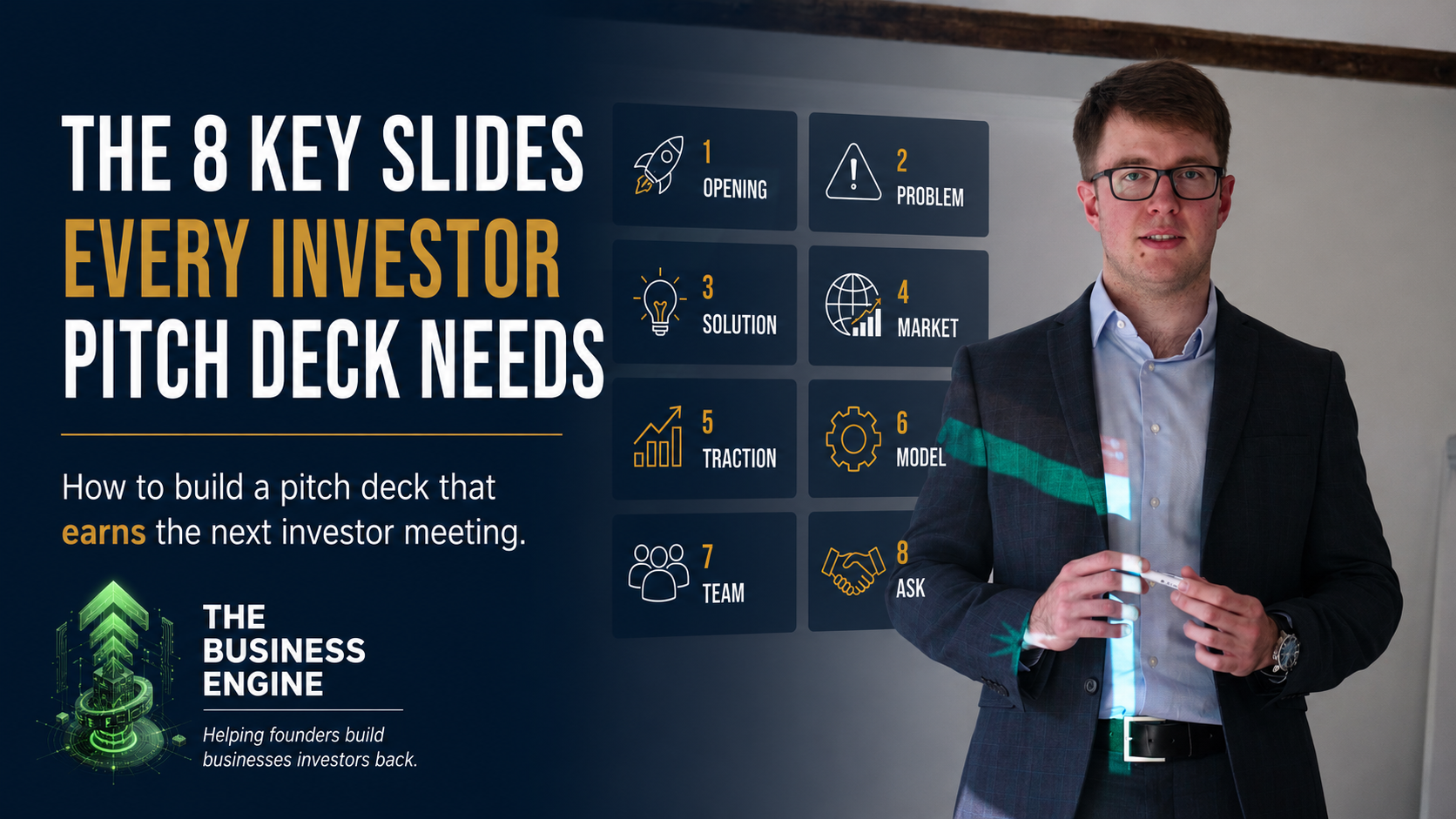
Every founder reaches the same moment: you have to stand up and tell your story.
Whether you’re raising £100,000 from angels or £10 million from a VC fund, there’s one reframe that changes everything – your pitch deck is not a presentation. It’s a sales document. And its job is not to explain your business. Its job is to earn the next meeting.
The most common mistake I see? Founders trying to teach investors everything they know about their technology. But investors aren’t buying your product. They’re buying the opportunity to build a valuable business.
Hold this thought as you read on:
“Investors back exceptional teams solving important problems in large markets – because that’s what produces extraordinary returns.”
Every slide should reinforce this idea. Here are the eight that do it.
-
The Opening Slide – make them remember you
You get one first impression. Keep it clean: company name, logo, and a single memorable line.
Skip the buzzwords. Instead of “AI-enabled next-generation digital transformation platform,” try: “Autonomous inspection robots that cut nuclear outage costs.”
If an investor remembers one sentence after you sit down, make it this one.
-
The Problem – prove the pain is real
Investors don’t fund clever technology. They fund painful problems.
Answer four questions: Who has this problem? How often? What does it cost them? And why hasn’t anyone solved it yet?
The best founders make investors slightly uncomfortable about how broken the status quo really is.
-
Your Solution – win the argument, not the demo
This isn’t a product demonstration. It’s a business argument. Explain what you do, why it works, why it’s better, and why competitors can’t easily copy it.
Focus on outcomes, not features. Customers don’t buy technology – they buy faster, cheaper, safer, or easier.
-
Market Opportunity – show the prize is worth winning
Investors need to see that success creates a large company. Walk through your TAM, SAM, and SOM, and back every number with credible research.
Where you can, show growth. A rising market means you ride the wave rather than fight the current.
-
Traction – proof people already believe
Often the single most important slide. Ideas are cheap; execution is hard – and traction is proof of execution.
Revenue, customers, pilots, letters of intent, partnerships, IP, awards, regulatory approvals: whatever you have, show it. Investors are hunting for momentum. Prove you’re moving faster today than you were six months ago.
-
Business Model – explain how you make money
Great businesses generate predictable revenue. Be clear on who pays, how much, how often, your margins, and your route to profitability.
Complicated pricing usually signals a complicated business. Keep it simple.
-
Team – why you, and why now
Investors back founders before they back products. Show technical capability, commercial capability, industry knowledge, and execution experience.
No team is complete. Be honest about the gaps and explain how this investment lets you hire to fill them. Self-awareness builds more confidence than pretending you have every answer.
-
The Ask – finish with clarity
Don’t make investors guess. Tell them how much you’re raising, at what valuation, how you’ll spend it, what milestones it unlocks, and why now is the moment.
If you’ve told the story well, the investment should feel like the obvious next step.
The mistakes I see again and again
Too much text. Explaining the technology before the problem. Claiming there’s “no competition.” Fantasy market sizing. Forecasts with no assumptions behind them. Thin traction dressed up as future promise. And no clear ask.
Your deck is built to start conversations, so give some credible input to go and start them!
The real test
A great deck isn’t about beautiful slides. It’s about a compelling investment story. By the time you sit down, an investor should be able to answer five questions without hesitation:
What problem are you solving? Why is your solution different? Why is this a large opportunity? Why is your team best placed to win? And why now?
Get those right, and you’ve built something more valuable than a presentation.
You’ve built confidence. And confidence is what investors are really buying.